


Machine Learning and Data Science Blueprints for Finance: From Building Trading Strategies to Robo-Advisors Using Python - HHShop68
-
Trang chủ

- Machine Learning and Data Science Blueprints for Finance: From Building Trading Strategies to Robo-Advisors Using Python - HHShop68

Còn hàng


Machine Learning and Data Science Blueprints for Finance: From Building Trading Strategies to Robo-Advisors Using Python - HHShop68
Tình trạng:
Còn hàng
Tác giả: Đang cập nhật...
Loại: Đang cập nhật...
Nội dung đang cập nhật...
[Xem chi tiết]
150.000₫
170.000₫
-
Mô tả
ĐẢM BẢO " KHÔNG LỖI , KHÔNG ĐEN HÌNH ,KHÔNG ƯNG HOÀN TRẢ TIỀN "
Bản in đen trắng - Bìa mầu, gáy keo nhiệt cực chắc chắn.
Giấy in ngoại nên viết vẽ và hightlight thoải mái.
Chất lượng rõ nét, chữ rõ ràng, giá rất tốt cho mọi người.
Mọi chi tiết xin liên hệ với Shop.
------------------------------------------------------------------------------------
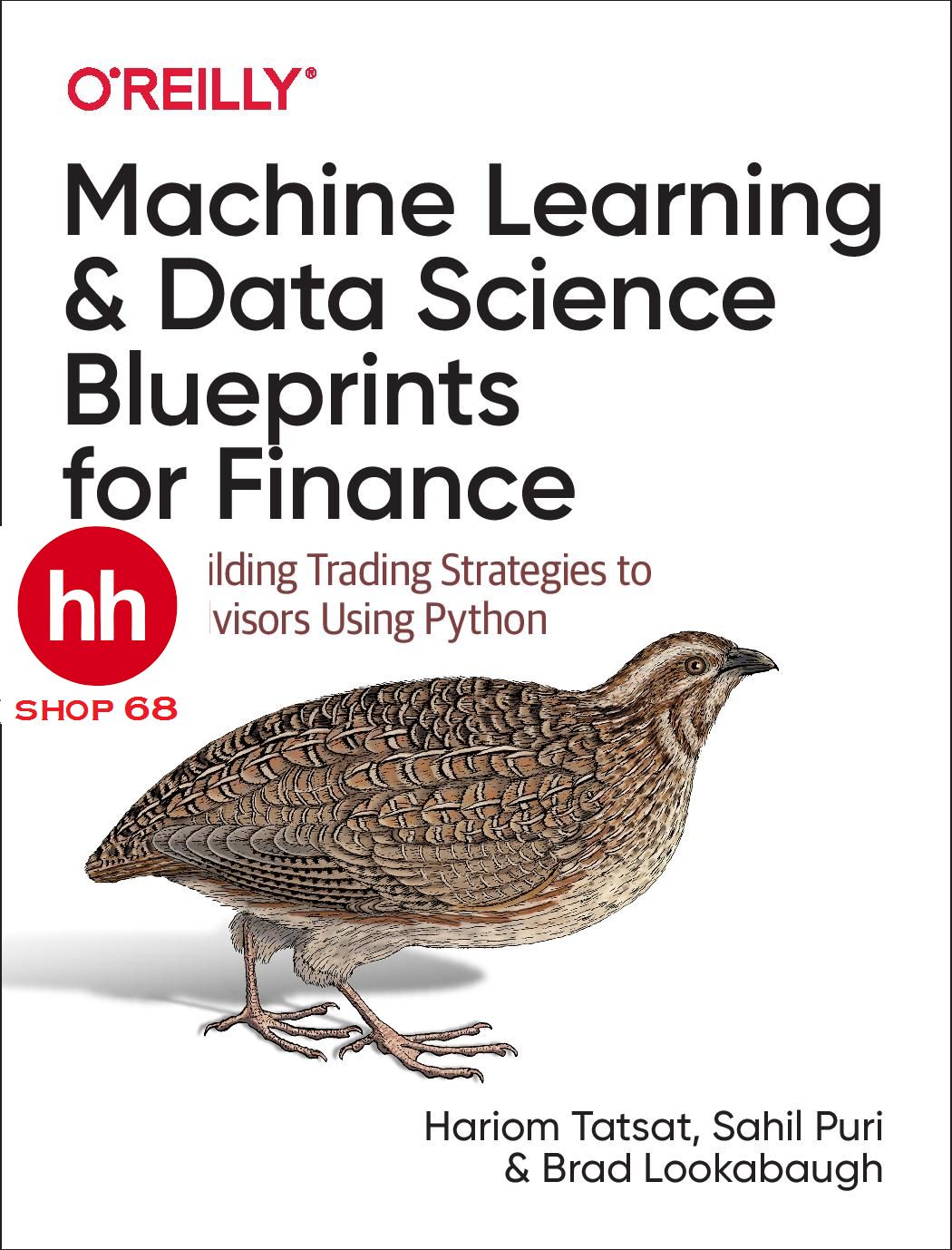
Machine Learning and Data Science Blueprints for Finance: From Building Trading Strategies to Robo-Advisors Using Python : 432 pages
Author : Hariom Tatsat, Sahil Puri, Brad Lookabaugh
Language : English
1) Book Description
The value of machine learning (ML) in finance is becoming more apparent each day. Machine learning is expected to become crucial to the functioning of financial markets. Analysts, portfolio managers, traders, and chief investment officers should all be familiar with ML techniques. For banks and other financial institutions striving to improve financial analysis, streamline processes, and increase security, ML is becoming the technology of choice. The use of ML in institutions is an increasing trend, and its potential for improving various systems can be observed in trading strategies, valuation, and risk management.
Although machine learning is making significant inroads across all verticals of the financial services industry, there is a gap between the ideas and the implementation of machine learning algorithms. A plethora of material is available on the web in these areas, yet very little is organized. Additionally, most of the literature is limited to trading algorithms only.
Machine Learning and Data Science Blueprints for Finance fills this void and provides a machine learning toolbox customized for the financial market that allows the readers to be part of the machine learning revolution. This book is not limited to investing or trading strategies; it focuses on leveraging the art and craft of building ML-driven algorithms that are crucial in the finance industry.
machine learning, data science, finance
Implementing machine learning models in finance is easier than commonly believed. There is also a misconception that big data is needed for building machine learning models. The case studies in this book span almost all areas of machine learning and aim to handle such misconceptions. This book not only will cover the theory and case studies related to using ML in trading strategies but also will delve deep into other critical “need-to-know” concepts such as portfolio management, derivatives, fraud detection, corporate credit ratings, robo-advisor development, and chatbot development. It will address real-life problems faced by practitioners and provide scientifically sound solutions supported by code and examples.
The Python codebase for this book on GitHub will be useful and serve as a starting point for industry practitioners working on their projects.
The examples and case studies shown in the book demonstrate techniques that can easily be applied to a wide range of datasets. The futuristic case studies, such as reinforcement learning for trading, building a robo-advisor, and using machine learning for instrument valuation inspire readers to think outside the box and motivate them to make the best of the models and data available.
2) About Author
Hariom Tatsat currently works as a Vice President in the Quantitative Analytics division of an investment bank in New York. Hariom has extensive experience as a Quant in the areas of predictive modelling, financial instrument pricing, and risk management in several global investment banks and financial organizations. He completed his MS at UC Berkeley and his BE at IIT Kharagpur (India). Hariom has also completed FRM (Financial Risk Manager), CQF (Certificate in Quantitative Finance) and is a candidate for CFA Level 3.
Sahil Puri works as a Quantitative Researcher in the Analytics Division at P.I.M.C.O. His work involves testing model assumptions and finding strategies for multiple asset classes. Sahil has applied multiple statistical and machine learning based techniques to a wide variety of problems; examples include: generating text features, labeling curve anomalies, non-linear risk factor detection, and time series prediction. He completed his MS at UC Berkeley and his BE at Delhi College of Engineering (India).

HHSHOP68
Sản phẩm đa dạng : Đầu sách phong phú. Nhận In sách theo yêu cầu.
HHSHOP68
Tư vấn nhiệt tình : Giải đáp mọi yêu cầu của khách hàng nhanh chóng.
HHSHOP68
Uy tín - Chất lượng : Bán hàng bằng cả trái tim.
HHSHOP68
Giá luôn luôn tốt : Giá luôn thấp nhất thị trường.


